A Billion-Dollar Impact
Fifteen years ago, the Lucas County Land Bank was an idea. Today, it's a billion-dollar reality.
When Rosemary and Alex Quinones took over Tex-Mex Tortilleria in 2020, they inherited more than a business — they inherited a South Toledo institution dating back to 1956. But parking along the busy Broadway corridor was killing them. Customers were leaving. Then someone connected them to the Land Bank.
Within months, nearby vacant land was cleared and converted into a dedicated lot. Boarded-up windows were replaced. The dark exterior opened up into something bright and welcoming. "People come in and say, 'Boy, you're really making the place look nice out here,'" Alex told us. Today, customers drive in from Michigan, Indiana, and Kentucky for Sylvia Reyna's original tortilla recipe.
That's one story. There are thousands more.
A new 15-year impact analysis, conducted by the Bowling Green State University Center for Regional Development, puts a figure on what Lucas County neighborhoods have experienced with this capable tool: the Land Bank has generated over $1 billion in total economic impact since its founding in 2010.
Read the full 15-year impact analysis →
Here's what that looks like on the ground:
4,396 deteriorated structures demolished. Each one was a drag on the entire block — suppressing property values, attracting crime, discouraging investment. Gone. These demolition investments alone generated $562 million in economic benefit on a $54.5 million investment — a 9:1 return.
908 buildings renovated or newly built. These aren't just statistics. They're houses where families live and thriving commercial businesses. These renovation and new construction investments generated $234.5 million in total benefits on just $18.3 million in Land Bank investment — a 12:1 return.
5,304 properties returned to productive use, restoring an estimated $26.8 million in property tax revenue to local schools, fire departments, and municipalities.
The overall benefit-cost ratio across all Land Bank activity: 8.39 — or $7 back for every $1 invested.
What does a billion dollars look like?
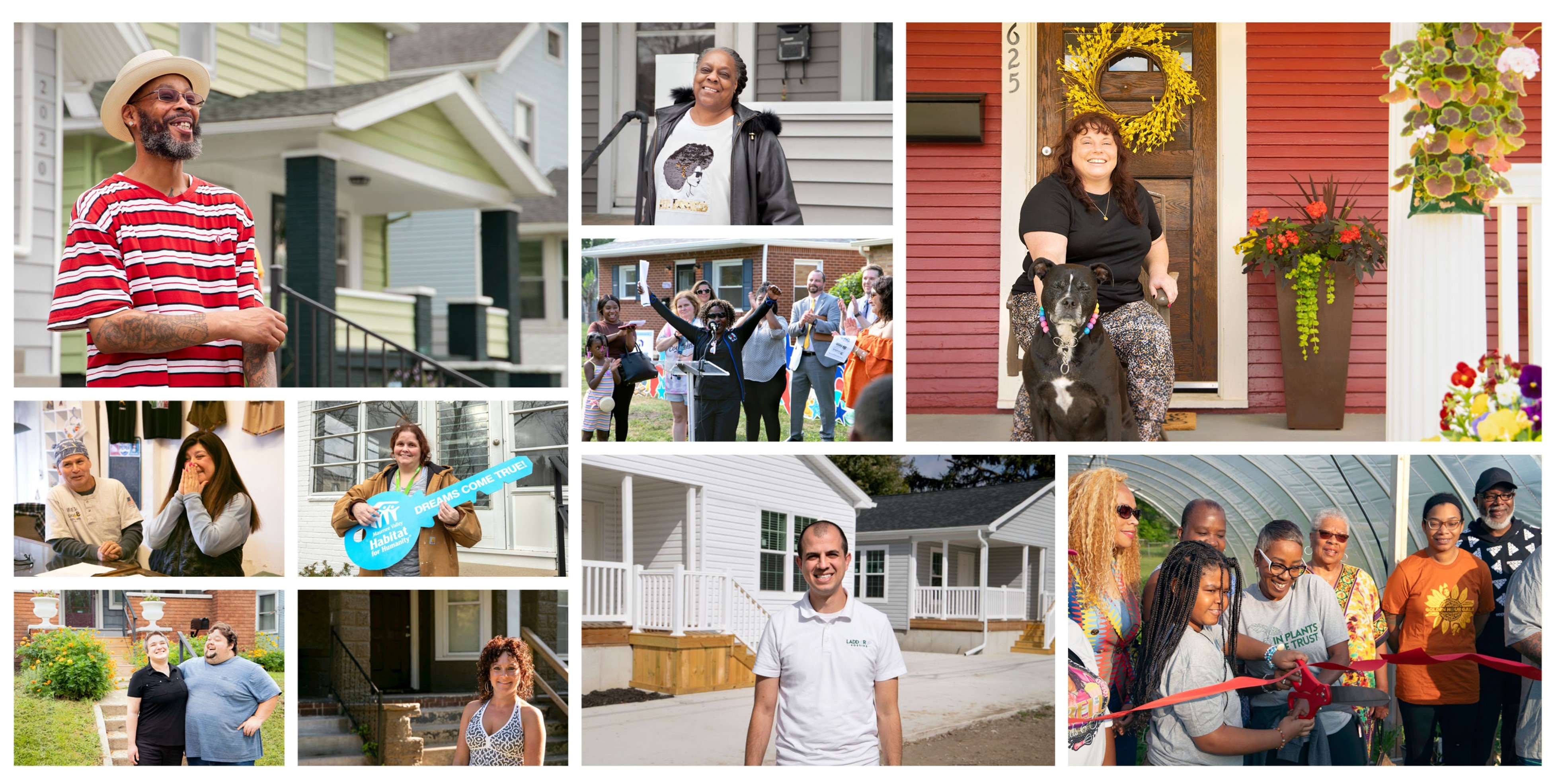
It looks like five families getting keys. In partnership with Maumee Valley Habitat for Humanity and the Welcome Home Ohio program, five first-time homeowners crossed the threshold into houses the Land Bank helped bring back to life. Five futures transformed. Five people lifted from a waiting list of hundreds still hoping for their moment.
It looks like Mz. Diva pulling into her driveway and getting excited — every single time. Her home, paid off nine years ago, sat in disrepair until lead-safe renovation grants transformed the exterior. "Every time I drive up the driveway, I get excited," she told us. "It's a brand-new home."
It looks like the old Baron Drawn Steel — a vacant industrial scar that sat empty for decades — coming down, and a neighborhood beginning to imagine a future again.
The report's most important finding is a simple principle: modest public investment, strategically deployed, unlocks dramatically larger private reinvestment.
The Land Bank doesn't do this alone. It does it by de-risking properties, clearing title, removing blight, and handing off to developers, homeowners, small businesses, and community partners who carry the work forward. Every dollar of public investment leveraged substantially more in private capital.
Fifteen years in, the evidence is clear. Where you live impacts how you live. And when the Land Bank gets to work, neighborhoods get better — one property, one family, one block at a time.